Product analytics telemetry

Product analytics telemetry for feature adoption and user behavior

Lumen helps product teams track feature adoption, user behavior, session paths, and live events with SDKs, REST ingestion, and raw event queries.

Region
us-east-1
Status
Beta
Raw event retention
1 year
Access
Included during beta

Lumen is beta software and is included at no additional product charge during beta. Its schema and retention behavior may change as the product evolves.

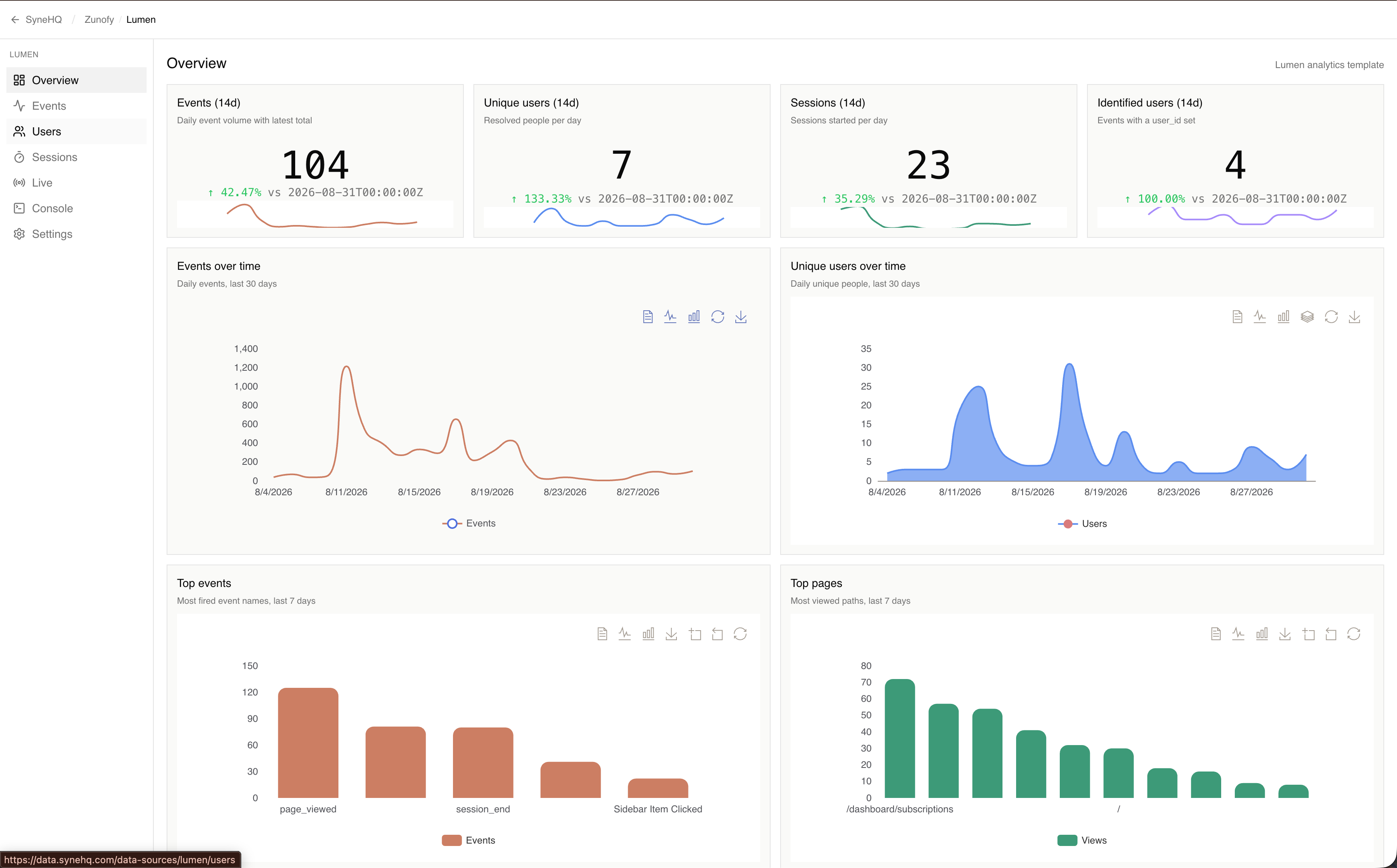
Lumen analytics overview showing events, users, sessions, and feature activity
Lumen analytics overview / Events, users, sessions, and feature activityOpen full size ↗

Lumen gives product teams a durable record of how people use a product. Send events from the client, backend, or REST, then move from a feature question to the sessions and raw records behind it.

Start with the activity that matters

Track the actions that explain whether a feature is being used: created a project, invited a teammate, completed a checkout, or returned after a notification. Lumen keeps events, users, and sessions connected so an aggregate does not lose the path that led to it.

Choose event names that describe completed actions, then attach the context needed to answer a later question. A release name, plan, entry point, or workflow step can make an adoption change understandable without guessing.

Useful starting questions include:

  • Which feature actions are increasing after a release?
  • Where do users leave a multi-step workflow?
  • Which users returned after an important action?
Illustrative interface

Lumen

Event ingestion workspace

REGION  us-east-1BETARETENTION  1yr

Overview / sample activity

Sample event activity

Example event volume
ExampleSample
Example users
ExampleSample
Example sessions
ExampleSample

Live service

Lumen Event Ingestion

Active

BACKING STORE

ClickHouse

INGEST MODE

Batch ingestion

INGEST STATE

Configured

API keys

Ingestion credentials

SAMPLE KEYS
  • NAME
    Production
    KEY
    lum_live_ee1a234a...
    SCOPE
    ingest:write
    CREATED
    Sample
    STATUS
    Active
  • NAME
    Default Ingestion Key
    KEY
    lum_live_8071b69c...
    SCOPE
    ingest:write
    CREATED
    Sample
    STATUS
    Active

Follow adoption from an event to a path

Use Events to compare feature adoption over time, Users to understand who took an action, and Sessions to review the sequence around it. Live shows incoming activity while you are testing a release or investigating a report.

When a chart raises a question, open the underlying event data instead of treating the summary as the final answer. Console provides raw query access for teams that need to inspect the records directly.

This makes it possible to work in both directions:

  1. Start with adoption and identify the users or sessions that explain it.
  2. Start with a reported session and see which product actions occurred around it.
  3. Start with a raw event and verify the properties that shaped the analysis.

A practical review loop

Review a release shortly after it ships, then return to the same events as usage settles. Comparing those windows helps separate initial curiosity from repeated behavior.

Use Live for immediate checks, and use sessions and raw queries when the question needs evidence from a specific path. The goal is a clear trail from the metric to the recorded activity.

Keep questions concrete

Name the feature, audience, and time window before you query. That makes findings easier to review with the people who own the workflow.

Lumen / product analysis

A clear record of what your product is doing.

Capture product activity, then inspect the people, sessions, and event data behind it. Lumen is included during beta.

01 / Capture

Instrument the product where work happens.

Send events from the browser or client, a backend SDK, or a REST endpoint. Keep the event name and properties close to the action they describe.

event intakeaccepted
track("report_opened", {
  source: "workspace",
  report_id: "rpt_204"
})

02 / Adoption

See which features earn a return visit.

Follow feature adoption and behavior patterns so product questions begin with observed activity, not a hunch.

feature activitythis period
Saved views
observed
Exports
observed
Alerts
observed

03 / People

Read the history behind a user.

Bring profile properties, recent events, and session context into one view when a team needs to understand a specific journey.

profile / usr_0184

plan
team
last seen
report_opened
sessions
recent context

04 / Sessions

Follow paths, not just page counts.

Inspect the ordered steps in a session to see how people move from an entry point toward a product outcome.

  1. session path
  2. 01Signed in
  3. 02Opened report
  4. 03Applied filter
  5. 04Shared link

05 / Live traffic

Inspect the event stream as it arrives.

Watch live traffic alongside event details and console or raw data when validating an instrumented flow.

live stream● live
  • report_opened10:40 UTC
  • filter_applied10:41 UTC
  • export_started10:42 UTC

06 / Data access

Ask deeper questions in the raw events.

Query the underlying event data when an aggregate view needs a closer look. Lumen is ClickHouse-backed, with a team-isolated tenant for each team.

raw event query

SELECT event, count()
FROM lumen_events
GROUP BY event

Send telemetry from the place work happens

Lumen accepts events through client SDKs, backend SDKs, and a REST interface. Instrument the product surface where the action occurs, and use backend events when a server-side outcome is the source of truth.

client SDK  -> interaction events
backend SDK -> completed work and system outcomes
REST        -> services and scheduled jobs

Use the transport that matches the event source. A client SDK can record a user interaction close to the interface; a backend SDK can record a completed job after the server confirms it; REST can connect an existing service or scheduled process.

Keep event names and properties consistent across those sources. The same action should not become three different events merely because it arrived through different instrumentation.

Ingestion keys can be created and revoked as team needs change. During beta, Lumen is included at no additional product charge. That beta inclusion does not establish future pricing, volume, or product terms.

Integration paths

An event envelope for every surface.

Start in the browser, on your backend, or over HTTP. Each sample shows the same event shape: a name, an identity, a timestamp, and properties that explain what happened.

Treat server timestamps, idempotency, and batching as integration considerations to confirm for your deployment—not assumed behavior in these examples.

01 / browser

Browser SDK

TypeScript

Send consented product interactions from the browser with a publishable or scoped key only when your Lumen configuration provides one.

analytics.ts
// Illustrative package naming: @synehq/lumen
import { lumen } from "@synehq/lumen";

lumen.init({
  key: "<publishable-or-scoped-key>",
  environment: "production",
});

lumen.track({
  name: "report.viewed",
  userId: "user_123",
  sessionId: "session_456",
  timestamp: "2026-09-02T14:30:00.000Z",
  properties: { reportId: "weekly-revenue" },
});

02 / server

Backend SDK

TypeScript

Keep server-side ingestion keys in your backend environment and emit operational events alongside the work that produced them.

events.ts
// Illustrative package naming: @synehq/lumen
import { lumen } from "@synehq/lumen";

await lumen.track({
  key: process.env.LUMEN_INGEST_KEY,
  name: "invoice.generated",
  userId: "user_123",
  sessionId: "session_456",
  timestamp: new Date().toISOString(),
  properties: { invoiceId: "inv_789", total: 4200 },
});

03 / http

REST API

HTTP + JSON

Post the same envelope from a job, service, or language without an SDK. The URL and authorization value below are examples.

event.json
POST https://api.example.synehq.com/lumen/events
Authorization: Bearer <server-side-ingestion-key>
Content-Type: application/json

{
  "name": "checkout.completed",
  "userId": "user_123",
  "sessionId": "session_456",
  "timestamp": "2026-09-02T14:30:00.000Z",
  "properties": {
    "orderId": "order_789",
    "currency": "USD",
    "total": 4200
  }
}

Integration checklist

  1. 01

    Name events consistently

    Use a stable verb-noun convention such as report.viewed.

  2. 02

    Choose an identity strategy

    Send a user or session identifier appropriate to the event.

  3. 03

    Respect consent and minimize data

    Capture only approved, necessary properties.

  4. 04

    Separate environments

    Keep development, staging, and production streams distinct.

  5. 05

    Validate before rollout

    Exercise representative events and inspect their shape.

Know where telemetry lives and how it is handled

Each team has a dedicated ClickHouse-backed tenant isolated to that team in us-east-1. Raw event retention is currently 1 year and is changeable. If deletion is requested, Lumen purges the data, including backups, within 30 days.

Customers control what they collect. SyneHQ processes Lumen data under the DPA. EU customers who need EU hosting or Standard Contractual Clauses should contact SyneHQ before relying on this beta service for that requirement.

Lumen is beta software. Its schema and retention behavior may change; export data before major version bumps when a durable external copy is needed.

Before adding an event, decide whether its properties are necessary for the product question. Collection choices remain with the customer, including what they send. Teams can also create or revoke ingestion keys as needs change.

The controls below collect the practical details in one place: tenancy and region, retention, deletion, collection ownership, and how to ask about EU hosting or SCCs.

Lumen data controls

Make the data boundary explicit before you send an event.

Current service location

us-east-1

Lumen is in beta. It is included at no additional product charge during beta.

Collection

You choose the inputs.

Your team controls what is collected. Review event fields before they enter Lumen and leave out what you do not need.

Processing role

Lumen processes under the DPA.

Lumen processes the data your team sends under the Data Processing Addendum (DPA).

EU needs

Ask before you route.

EU customers can contact SyneHQ to discuss EU region hosting and Standard Contractual Clauses (SCCs).

Retention lifecycle

A visible path from collection to purge.

Raw event retention is 1 year. During beta, retention and schema may change, so keep an export before major version bumps.

  1. 01

    Choose what to collect

    Your team controls what is collected before sending events to Lumen.

  2. 02

    Operate in beta

    Raw event retention is 1 year and can change during beta.

  3. 03

    Export before major changes

    Schema and retention may change during beta. Export your data before major version bumps.

  4. 04

    Delete the tenant

    Deleting a tenant purges all data, including backups, within 30 days.

Operator checklist

Keep the controls operational.

Use this as a practical review before collection, during beta changes, and when ending a tenant.

  • 01

    Minimize collection

    Review each event and collect only the fields your team needs.

  • 02

    Rotate keys

    Rotate any keys used to send data to Lumen on your operational schedule.

  • 03

    Keep exports

    Export data before major beta version bumps so you retain the copy you need.

  • 04

    Plan deletion

    Use tenant deletion when you no longer need Lumen data; allow up to 30 days for purge, including backups.

Bring the question, the work, and the answer into one governed workspace.